


14th Sunday, Year C
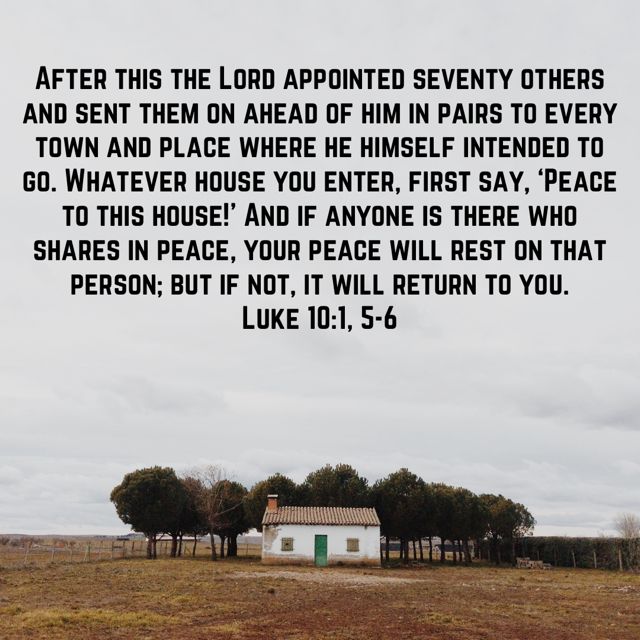
The opening words of the Gospel tell us this: “…The Lord appointed seventy-two others and sent them two by two ahead of him to every town and place where he was about to go.” Here is a Jesus with a calendar and a diary, a man who knows exactly where he is going and is organised enough to send outriders ahead of him to prepare the way.
This reminds me of what is happening in today’s world, before any big event flyers and posters are send out to advertise this big event. Any organiser of such big events would know very well the importance of this preparatory act of advertising a concert.
Are not the seventy-two in this Gospel a bit like the posters in our time? The seventy-two were the out-riders who went ahead to preview the main event which was to come. While the task of the posters was to sell tickets, the task of the seventy-two was, perhaps, to determine the faith level in the town or village, to gauge the level of welcome and support they might get, to drum-up support and interest, and probably check on places to stay while they were there.
Just as the circus posters used the colours and images of the various acts to create excitement in advance of the event, it seems that the seventy-two were to “heal the sick who are there…” and proclaim that “The kingdom of God has come near to you.” There is no doubt that stories of miraculous healings circulating the local area would draw the curious as well as the sick when told that what they had witnessed was just a preview of the main attraction, Jesus, who was coming to their town.
Jesus in this Gospel is not a wandering iterant preacher but a man on a Mission. He is organised and astute, with aims and objectives.
Jesus in today’s Gospel was a pragmatist, astute and aware of the political world in which he lived, and alert to the dangers he faced.
This is made clear by the strange instructions he gave the seventy-two before sending them out: “… I am sending you out like lambs among wolves. Do not take a purse or bag or sandals; and do not greet anyone on the road.” Any self-respecting person would cringe at the idea of sending someone on a mission with these last words. The ‘Kingdom of God’ preached by Jesus was utterly different to what was expected by the Jewish people.
The ‘Messiah’ who would bring forth this Kingdom would not be a military or political leader. He would not punish, once and for all, the enemies of the Jews, and the Kingdom of God would be open to all people of faith.
Jesus knew that his message was counter-cultural and would profoundly challenge the values and beliefs of society. He made no apology for that. In fact, he died because he refused to compromise the Kingdom he preached. By the time he made his last trip to Jerusalem he knew that holding true to the values of the Kingdom of God could have but one outcome his own death. Despite the fears, doubts and pain of Gethsemane he did not waver; the Kingdom of God was real and its coming had begun in and through himself.
His instructions to the seventy-two reflect, not an idealist, but a man deeply rooted in the reality of his world and deeply aware of the inevitable clash between the Kingdom of God and the Kingdoms of this world.
The message the seventy-two brought of peace, forgiveness, gentleness, tolerance and compassion would make them, as the Gospel says, “sheep among wolves.” Preaching it would be an annoyance more than a problem because it could be ignored or ridiculed.
However, once the implications of ‘forgiveness’ or ‘tolerance’ or ‘peace’ were made clear in concepts like ‘justice’, ‘compromise’, ‘acceptance of those different to us’, etc. then the Kingdoms of this world would reject them. Then, indeed, would they find themselves “sheep among wolves.”
Notice also how strongly Jesus voices this warning. We usually imagine one or maybe two wolves infiltrating a flock of sheep, then picking off some of the weakest. But Jesus reverses this image! Can you imagine a pack of wolves with maybe five or six lambs among them?
This may also explain the rest of the instructions he gives them, “Do not take a purse or bag or sandals; and do not greet anyone on the road.” They are to travel light, without drawing attention to themselves, without any sign of ostentation or showiness. They are to be careful who they speak to, where they stay and who they trust – they are lambs among wolves and will be devoured if not careful.
From the Gospels we know that during his ministry Jesus was made aware of several plots to kill him – once being warned by some Pharisees of a plot by the Herodians. Telling the seventy-two to be careful who they spoke to and who they trusted was not idle chatter or being overdramatic. It was a real and present danger.
We, too, like the seventy-two, are sent out “like lambs among wolves”, and, like the seventy-two we are instructed by Jesus to be alert, astute and aware of the cultural and political milieu in which we live and act. We bring a message of joy, peace, gentleness and forgiveness to a world, which is hostile to that message. We witness to Resurrection, life and hope in a world where these values are increasingly undermined and spoken of as irrelevant.
The message of Jesus and the dawning of the Kingdom of God in our world must be lived and preached by us in such a way that it is real and relevant. Jesus in his time recognised the wolves who sought to destroy him, and he avoided direct confrontation with them until he knew, deep within himself, that the time was right and his message had sufficiently taken root to survive without his physical presence among them.
Hence, we pray for more and more labourers who are ready to be true ambassadors of Christ in this world. As Jesus Himself said, the harvest is rich but the labourers are few, in this month of praying for vocations we pray for more vocations to priestly and religious life.