


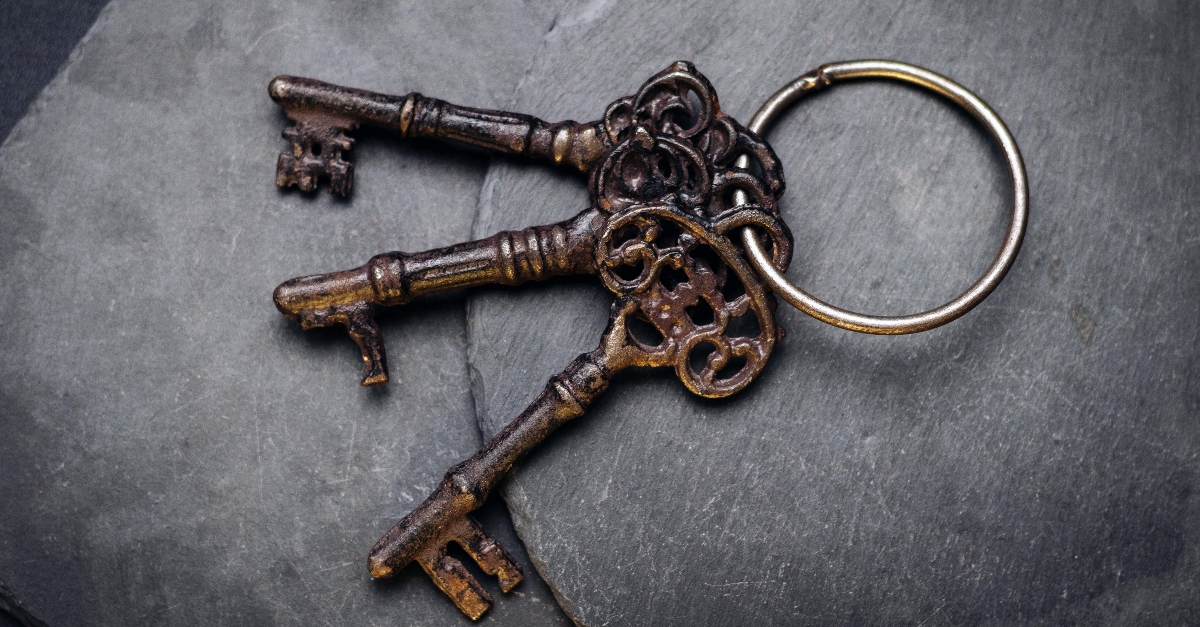
The handing over of the keys to Peter by Jesus is one of the foundational texts used since the earliest centuries to confirm and support the Petrine office of the pope of Rome. The Church year gives us the opportunity to celebrate this feast liturgically on 22 February, the Feast of the Chair of Saint Peter, the Bishop of Rome. There are also other feasts in the liturgical year, such as the Solemnity of Saints Peter and Paul on 29 June, as well as the Feast of the Martyrdom of Peter, each with a different emphasis. The keys, however, are central to the Feast of the Chair of Peter.
The text that the Church places before us in today’s Gospel—which has its own context, progression, and meanings—also provides the basis for several representations in art, all of them deeply impressive. It has also supplied the principal motif for the pope’s coat of arms: on his shield, the keys of Peter are the dominant image together with the papal tiara, whereas other bishops have only the bishop’s hat on their coat of arms.
The fact that Peter carries the keys to the gates of paradise is also the origin of countless stories about how one must first give an account of oneself to him and persuade him to please unlock the gates. I will certainly take along some ostrich biltong to strengthen my case.
The bringing together of the Gospel text with the first reading from the prophet Isaiah, which concerns the handing over of the key of the house of David to Eliakim, brings to the fore for me this time the true use of keys in our daily lives. I surrender myself to the prompting of the Lord’s Spirit, who wants to draw me closer to him in this way, through the ordinary things around me. Keys lock and unlock.
Just last week, I was part of a group that gathered from the IMBISA region to reflect and talk about the influence of synodality on priestly formation in our seminaries and its eventual impact on our parishes. It is a good and noble task in today’s Church. But that is not what I want to talk about—rather, about keys.
At the beginning of the week, the host of the centre where we were staying in Dobra, Namibia, warned us to keep the doors locked, because the baboons would not think twice about making use of an open door. They know where the food is, and perhaps they would rummage through our belongings out of curiosity. Along with the key to our rooms, we were also given the key to the main door of the various accommodation units, and the priest told us that we had to use it. Keys keep things out, and they give us access.
This is perhaps something worth considering: how keys keep out, hold back, separate, and make things inaccessible. How do we use the proverbial keys to exclude people? To keep them away? These questions arise with particular urgency now that we are surrounded by the spirit of synodality—the awareness awakened by the Second Vatican Council and eventually brought into our daily lives and conversations, even if it has taken sixty years. It takes time for the teachings of a council to be received by the Church.
On this synodal journey, on which the Church in every part of the world has deliberately embarked, one of the many questions it raises is precisely this: Which people do we exclude, why do we do so, and how do we regard them—as fellow pilgrims on the journey or not?
I am always struck by the fact that, when we were still in the early stages of thinking, writing, and speaking about these matters, one theologian immediately referred to the way in which the Church in his country treated young single mothers—as people placed on the margins, sometimes subjected to strict rules and regulations that separated them from the faithful in order to keep the Church’s life clean and pure.
This will always remain with me as a strong rebuke to an attitude that seems fairly universal: that, in our own righteousness, from our lofty thrones, we may judge others. And then that theologian-priest reminded us, in the words of the Virgin Mary in her hymn of praise, the Magnificat, that the Lord casts the mighty from their thrones.
This is also stated very clearly in today’s responsorial psalm: “Though the LORD is on high, he sees the lowly, but he recognizes the proud from afar” (Psalm 138:6). The warning leaves no room for doubt: the Lord knows my heart; after all, he made it. It calls us to conversion—to turn around, to recalibrate, whatever we may wish to call it. For James asks us directly, without hesitation: “But who are you to judge your neighbor?” (James 4:12).
Where did we receive keys? Baptism is the key to eternal life, which we receive at the beginning of our earthly lives—though for some, it comes much later. In his conversation with Nicodemus, Jesus said:
“Amen, amen, I say to you, no one can enter the kingdom of God without being born of water and Spirit” (John 3:5).
That sounds like a key. Is living out our baptismal promises—believing in the Lord and dedicating our whole lives to him—a key that we can lose, misplace somewhere, or forget amid the attractions of life and the bodily nature of our existence?
I once shared a house with a priest who was the very image of the absent-minded professor. He and keys never got along well. That was simply how things were. He would leave them somewhere, forget where he had put them, or hide them in a place he thought he would remember when he needed them again. Nothing ever worked out. And in an environment where crime was rampant, the fear that the keys might fall into the wrong hands was always at the forefront of one’s mind.
Is there something we can learn from that poor priest’s absent-mindedness about misplacing the key of life? Our thoughts are not here with us and with the task at hand; they are always somewhere else. “Keep your eyes upon Jesus,” the hymn says.
“Yes, like the eyes of servants are on the hand of their masters, so our eyes are on the LORD our God, till he has mercy on us” (Psalm 123:2).
Furthermore, when you lose your keys or lock them somewhere inside, you yourself are also locked out. You cannot get in. What lesson is there for us in that? Perhaps that our own absent-mindedness, indifference, and unwillingness to pay attention—our tendency to remain unmoved by the joys and hopes of others, by their struggles and hardships—lead us to use our keys to keep them away from us, while we remain safe in our own little world.
We lock them in, shut them out, and close them off. But what about unlocking? Have you ever had a bunch of keys and had to try several of them before finding the right one? It can be troublesome when the telephone is ringing inside, for those who still have landlines. Or when you are in great need and simply have to get inside at that very moment. And, as fate would have it, the door only opens with the fourth key—and then you have to kick the door in to get through.
Ultimately, the most convenient key is a master key, one that unlocks everything. How it works, only heaven knows. But I can imagine that having a single means of access could make life very convenient, just as the digital world encourages us to do.
That master key is Jesus himself, who came to live among us in our flesh and came to save us in our humanity. “There is one mediator between God and the human race, Christ Jesus, himself human” (1 Timothy 2:5). Without him, we have no access to the Father, because “no one comes to the Father except through me” (John 14:6).
Jesus is our master key, the key that unlocks every door, even death (see Revelation 1:18). In his Father’s house there are many dwelling places (John 14:2). He is the key to those many dwelling places. He even says:
“I am the gate. Anyone who enters through me will be safe. He will go in and out, and find pasture” (John 10:9).
He is “the Messiah, the Son of the living God,” as Peter, the bearer of the keys, confesses in today’s Gospel (Matthew 16:16). He who is the Christ is the key to eternal life; he is the door.
Come! Come, let us enter.