


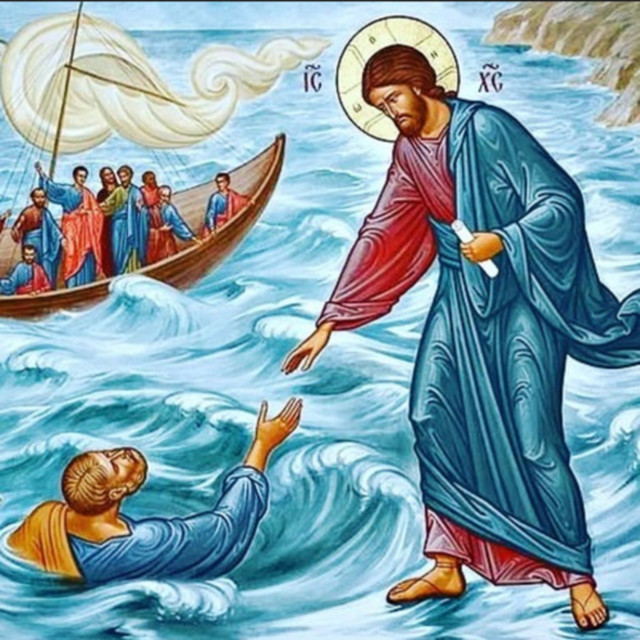
Nineteenth Sunday in Ordinary Time, Year A.
Readings: 1 Kings 19:9.11-13; Romans 9:1-5; Matthew 14:22-33
The life of faith is full of paradox, apparent contradictions that can co-exist in the life of the believer. Philosophers like Kierkegaard had much to say about this.
Elija did not consider it a possibility that God could appear in the gentle breeze. Yet God can be in the earthquake, as was the case with Moses, and he can also be in the storm. The two realities are not mutually exclusive. This reminds me of the section on neo-gnosticm in the exhortation “Guadete et Exsultate” which deals with the dangers of exaggerating the importance of human certainty and knowledge.
It points to all the unexpected and mysterious ways in which God is present in the world, in the life of each person, even when the lives of such persons seem to be disastrous. God is present where we least expect Him. It invites the reader to remain open to the transcendence of God, over and above human expectations. We cannot control or determine in which historical circumstances he may or may not be found. The time, place and manner of encounter does not depend on us. God is full of surprises.
Hence faith can never equal certainty. Faith co-exist with uncertainty. It is “a leap” from human certainties to consider the truth of what is humanly impossible. It is trust.
Peter trusted the Lord. He believed that it was Jesus calling him: “Come to me across the water.” He did so, doing the “impossible”, yet he was also afraid and became overwhelmed by the situation. Faith is never perfect. It is never simplistic. No matter how much we want it to be or how much comfort we seek to derive from certainty. Certainties are almost always shattered by the realities of life.
This theme occurs again and again in the life of Peter. At Caesarea Philippi, he had the greatest revelation and also the greatest misunderstanding of his life. On the eve of the passion, he was brave, cutting off the ear of the High Priest’s servant, and he was afraid at the same time, hence his subsequent denial.
Another way of looking at paradox and complexity is from the existential point of view of Victor Frankl’s “Man’s search for meaning.” The insight that suffering can be meaningful and that the very reality humans are inclined to avoid, might be the one thing that gives meaning to life. Life is full of paradox and so is faith.
We want to be free but not isolated and so we give up some of our freedom in order to belong, we want to change or grow but we do not want to endure the suffering that it entails. Much of our lives is spent in activities of self-protection and self-preservation and these turn out to be the very things that prevent us from finding what we truly seek. This may all sound very complex.
That, however, is the human reality, including our life of faith. It is never either-or, black or white. Like Peter we want to remain in the safety of the boat, but we also want to walk to the Lord upon the water. Hence the need for grace.
The grace of God holds these tensions, and it is resolved by trust. It is precisely in accepting the reality of our condition and the realization of our dependence on God’s grace that compels us to pray with St. Augustine:
Grant what you command and command what you grant.
It is in holding space for our complexities that we are healed and that is where real growth in holiness happens and where God’s mercy is revealed. Our complexities make us totally relient on God, our uncertainties on the the certainty of his presence, even where it is least expected or where he is apparently absent: in the messiness of people’s lives, the ideological wars within the church, the scandal of division amoung Christians, the perpetrating and condoning of violence by otherwise seemingly moral characters, the exclusion of those who are different and so we can continue.
This complexity is simplicity.
Sound like a paradox? Not to worry! He says:
Courage, do not be afraid. It is I.