


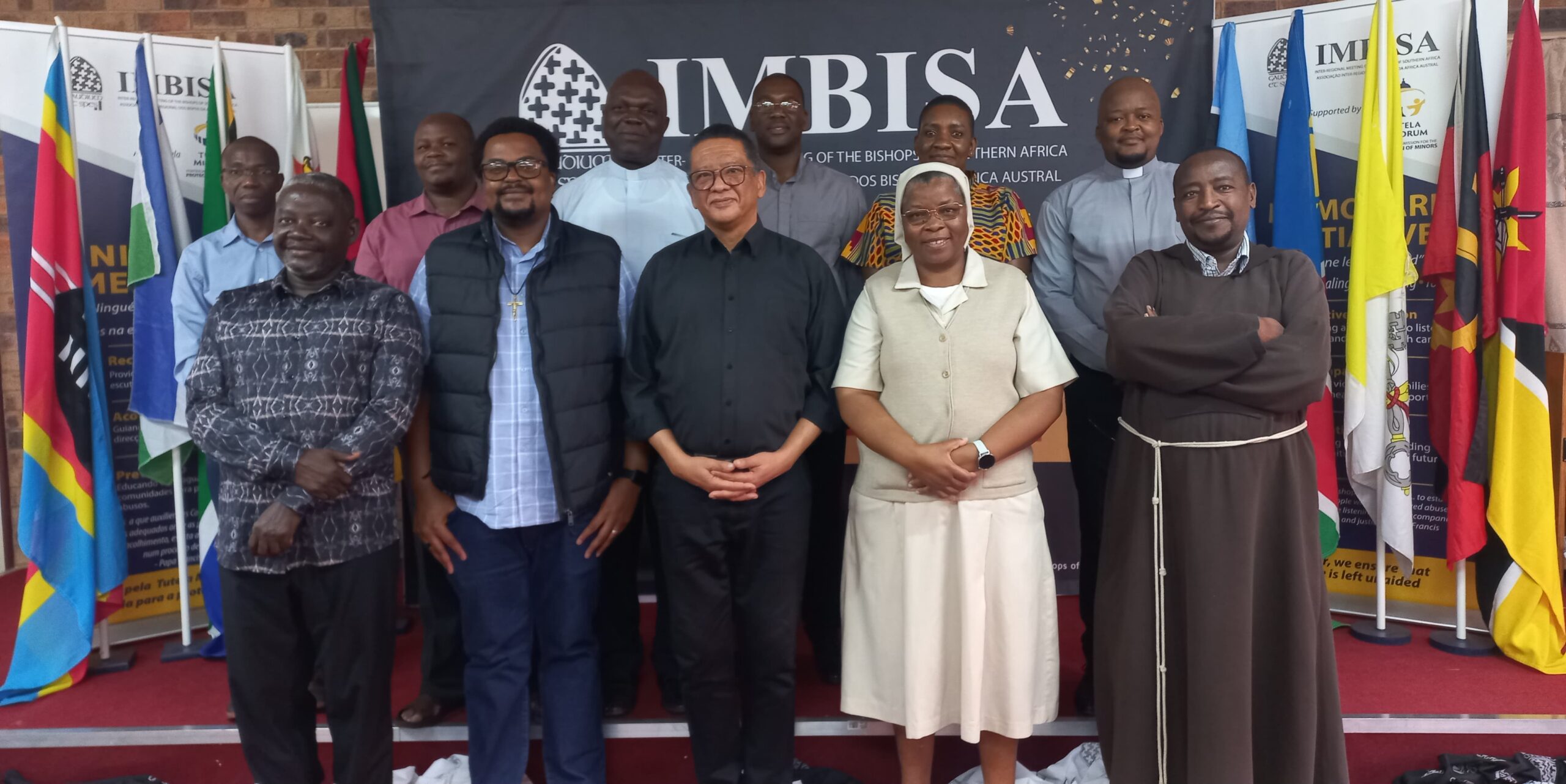
IMBISA held a gathering for theologians to examine the task of inculturation in general and paying particular attention to polygamy.
Participants from Angola, Lesotho, South Africa and Zimbabwe came together at the Padre Pio Spirituality Centre in Pretoria, South Africa, from 2 to 6 November 2026.
The meeting, held under the theme: “Embracing inculturation, traditional beliefs, and synodality for a liberating Church in IMBISA” took place under the auspices of the Pastoral Department of IMBISA. It aimed to provide an opportunity for theologians from across the region to reflect on the challenges and opportunities presented by inculturation and to explore the implications for their mission in a synodal Church.
The two experts who led participants in the workshop were Sister Estér Lucas José Maria FC, and Father Ian Mberikwazwo Chitambo OMI.
Sr. Estér is a member of the Congregation of the Daughters of Charity of St. Vincent de Paul in Mozambique, holds, among others, a doctorate in Humanities from the University of Mozambique and a degree in Biblical and Systematic Theology from the Institut Catholique de Paris. She participated in the Synod on Synodality as a delegate from the African continent. Sister teaches in the major seminary in her home country and currently serves as a pontifical commissioner in France for the Congregation of the Mother of God.
Fr. Ian is an Oblate of Mary Immaculate, under the Province of OMI of Southern Africa. Born in Zimbabwe, he currently serves in South Africa at St Joseph’s Theological Institute as a lecturer and fundraising officer. He did his formation and priestly studies in Zimbabwe, South Africa, and Cameroon. His area of interest is ‘all things African,’ actively pursuing decoloniality, political theory, African traditional religions, inculturation and personhood.
As participant in the synod, Sr. Estér was well placed to unpack the genesis and history of the theme of study group 10 on polygamy. As co-author of the final report submitted through SECAM, she unpacked the document for participants, giving a first-hand account of the steps taken by the commission that was responsible for the study.
While participants accessed the document through the synod website, Sr. Estér lead them in a summary thereof, describing the background of the document through studies in various parts of the continent that went before it. She made constant reference to the lived experiences of growing up in polygamous families, also of some of the members of the commission.
She emphasized that the choice often made of baptising the husband with only his first wife characterised most of the earliest contact the Church had with families in such situations. Therein was a serious pastoral challenge, since, as the commission voiced the discernment of many current pastors and pastoral workers, the second or third wife and their families were often neglected, which opened the path to injustice.
Keeping those wives in some kind of permanent catechumenate and not allowing them access to the sacraments is the basis of another grave situation in which pastors are often forced to deny them the healing and grace of a sacramental life.
Despite the fact that it is called the final report, as are others, it does not mean that it is written in stone and that the final word was spoken, Sister Estér emphasized. It simply means that in all the disciplines of the sacred sciences, especially those of sacramental theology and canon law, listening to those families and accompanying them, we need to find a theological and pastoral approach that will not exclude anyone, not the second or third wife and family.
Such listening will help us enter into the reasons of particular families for entering into polygamous marriages. It will force pastoral agents to welcome members of such families instead of excluding them.
It calls for courage, Sister said after participants shared their group work according to Conversation in the Spirit method. It was noted that we in Africa are fearful of what the rest of the Church will say about this. The result is that we are the first ones to hold preferences against studying this phenomenon and others in our cultures. There is a kind of self-denying of who we are, accompanied by a distrust of ourselves as Africans.
Fr. Ian built on this and said if we work in inculturation, we need to engage the African condition, as we would talk about the ‘human condition.’ But there appears to a reluctance to do this, since, in becoming a local Church properly meant, we keep before ourselves the demand that it has to retain “compatibility with the Christian message and communion with the universal Church” (EA 62). Said Fr. Ian, “We so much want to be part of the universal Church, that we want to fit in and fit in correctly,” referencing the early workers of inculturation in Southern Africa, including his late OMI confrère, Fr. Stuart Bate.
Engaging the historical trajectory of inculturation, Fr. Ian showed how this work is not one of fashion whose time has come and gone. He demonstrated how the earliest workers of inculturation and leaders in the Church called for an African council – held in Africa. The fear of the African condition, held mostly by Africans themselves, contributed to this dream never being realised. Instead Synods of Bishops on Africa were held in Europe.
The implementation phase of the Synod on synodality aims to examine new practices and structures that will make the life of the Church more synodal. Fr. Ian said that this is an opportunity to exchange of gifts developing the communion of local Churches within the one Church, mainfesting its catholicity while working towards respecting legitimate diversity. For us to accept that there could be legitimate diversities resulting from our African condition is a challenge, since we seem not shy, but afraid that those diversities will separate us from local churches elsewhere.
We therefore sacrifice this for a communion often maintained through financial support. We ought to acknowledge our part in this, namely our self-sabotaging attitudes. It is not surprising to discover that very few among us are studying the African condition, yet it does not have to be approached as a mysterious unknown, for we live it.
There are many questions to be answered, if we want an open discussion on the work of inculturation, showed Fr. Ian. The philosophical question that stands out is the one of epistemic authority, namely, for example:
Who determines what constitutes authentic African culture? Who decides which African traditions are compatible with Christianity? Why are some African cultural practices incorporated into Christianity while others are condemned? Why does European Christianity sometimes appear as the universal theological standard against which African expressions are evaluated? Can African Christianity transform the theological and institutional assumptions inherited from European Christianity?
Participants were happy to know that the final word on polygamy was not spoken by study group 10. This meant that they themselves need to roll up their sleeves. They acknowledged that the shame of getting involved pastorally with families living in polygamous situations should be interrogated according to a basic synod question: whom have we left out of the discussion?
Encouraged and challenged by the depth and expertise of the presentations, participants aim to work together on a publication that will serve the region’s pastoral workers in reflecting on the duty of inculturation and the ministry towards those in polygamous marriages and families.