


SECOND SUNDAY OF EASTER
Introduction
Dear friends today we are celebrating the second Sunday of Easter also known as Divine Mercy Sunday. Today’s readings invite us to experience the risen Jesus in a deeper way through community, hope and peace. As we celebrate we are invited to move away from fear, from doubt to faith, trust and a life of love.
First reading
The first reading from the Acts of Apostles gives us a beautiful picture of the early Christian community just after Pentecost. Historically this was just the time the church was beginning in Jerusalem. The Holy Spirit just came down upon the apostles making them to move many to believe in Jesus. These new believers did not just follow Jesus individually; they formed a strong united community.
The passage tells us four imported things they were devoted to:
- the Apostles’ teaching,
- fellowship,
- the breaking of the bread and
- prayer.
This showed that both spiritual and practical were important to them. It means that they stayed connected with one another, and shared meals including the holy Eucharist.
One striking feature was their generosity. They shared all they had so that no one was in need. This does not mean they had the same things but it emphasized that they cared deeply for one other. Their love was visible in action.
Faith did not just mean to believe but it was lived experience in prayer. They lived in simplicity, met at home, and shared together, prayed together and praised God with sincere hearts. This was so attractive to others that they joined their prayer life.
For us today, this passage is both inspiring and challenging. It shows us that being a Christian is not just being in personal prayer but also being a community. Do we participate in those zonal SCC meetings? Do we participate in the associations to meet others and know other people in our area who are not in the church? The early Christian community grew because of authentic living. People seeing faith, love, unity in action and people were drawn by it.
This passage invites us to appreciate that faith is lived and shared together. Is there someone in our parish we avoid, not sharing with them our joy and simplicity? This is a challenging invitation to check if our church is a place of prayer. It is a call to care for the needy.
The early church was not perfect, but it was a place where people grew together, served one another and made room for others. When community is like this it becomes a witness to God’s grace.
Second reading
The second reading taken from First Peter reminds us of the joy of the resurrection that enables us to have a living hope built on joy, strong, lasting and rooted in God’s promise. When life is difficult this hope keeps us going.
He even speaks about the inheritance kept for us in heaven. This means that what God has prepared for us will never change or get lost, for God’s promise remains secure. This gives us confidence and power.
Peter is realistic about life, saying that we will experience hardships in our life. The challenge he holds out for us is that we love Jesus even though we have not seen him. Our faith is based on trust. Life today brings abut challenge and struggles, but Peter reminds us to remain in trust and hope, to remain faithful to God and discover a lasting joy.
Gospel reading
Today’s gospel presents the reality of outside as opposed to inside. After the death of Jesus, the disciples were afraid, confused and uncertain about the future. Jesus stands among them saying, “Peace be with you.” Jesus does not remind them of their weakness; rather he meets them in their weakness and forgives them. The same Jesus is coming to us today.
No sin is greater than his mercy. This is all about the divine mercy we receive from our Lord. When we accept his forgiveness our fears begin to fade and we experience true joy. When forgiveness fills our hearts, we learn to live a life of forgiveness to others. Even though the doors are locked Jesus enters freely, no failure and no weakness can keep him away.
When he comes into our life, he brings courage and hope. He may not do away with all our problems, but he is giving us courage to face whatever situation we may come across.
Jesus is entrusting his disciples with forgiveness. The community that forgives is a community that lives in peace.
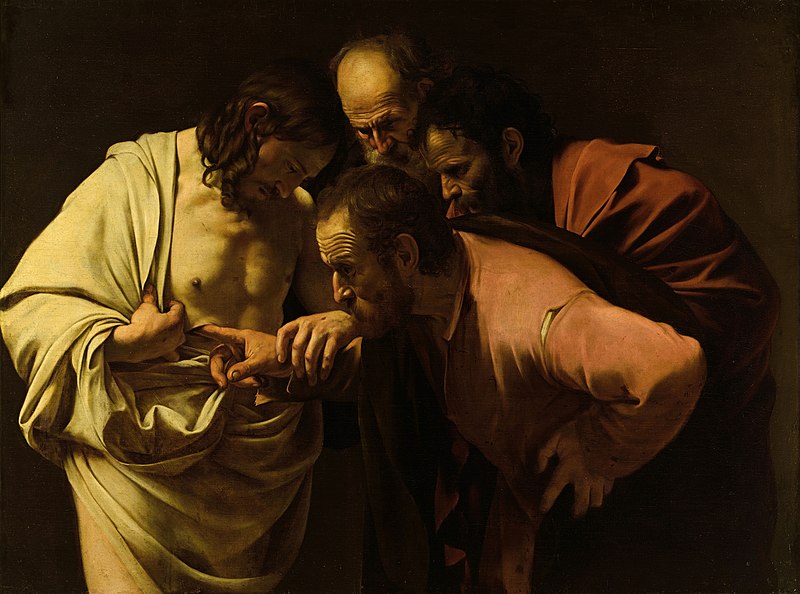
We then meet Thomas; his doubts are our reality. Jesus did not reject him, rather he gently leads him to faith. His response is to acclaim, “My Lord and my God,” which points to a deeper faith, for Jesus says to him, “Blessed are those who have not seen yet they believe.” That is us. We did not see Jesus, yet we believe and trust in him.