


Seventh Plenary Assembly – 2004
The seventh plenary assembly of IMBISA took place from Monday 1 October to Saturday 16 October 2004 at the Chishawasha Seminary in Harare, Zimbabwe. The theme of the plenary was Towards a self-reliant Church in Southern Africa.
From: Welcome address by Bishop Louis Ndlovu, President of IMBISA
As the Plenary Assembly this year, we need to take special note of the issue of levies paid by each of the conferences. They have remained the same for the past 25 years. There is definitely a need for us to revisit this issue if we want to move towards self-sustenance or self-reliance as we have aptly chosen this year’s theme.
From: Report of Department of Theological Reflection and Exchange by Fr. Peter Mufaro Siziba
There was a joint meeting between AMECEA and IMBISA on the project of a textbook or manual on African Traditional Religions (ATRs) for use in seminaries and formation houses. The meeting was held at the Catholic University of Eastern Africa (CUEA) on 7 December 2001. The purpose of the meeting was to reflect on the syllabi and recommendations from the seminaries and map a way forward.
From: Report of the Refugee Services Department by Sr. Stella Takaza SJI
Soon after the last plenary assembly, three bishops from Angola, comprised of Archbishop Damião Franklin of Luanda, Bishop Gabriel Mbilingi of Luena and Bishop José de Queiros Alves of Menongue Dioceses visited the refugee camps in Zambia that was hosting many refugees from Angola. The purpose of the visit was for pastoral solidarity with the Church in Zambia and the refugees who have been in exile for many years.
From: Presentation entitled Towards a self-reliant Church: creating a new society for children by Sr. Aine Hughes, HC of CARITAS, South Africa
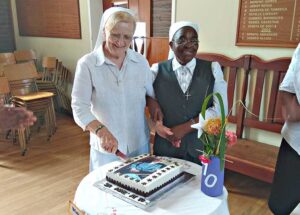
L: Sr. Aine Hughes, at her 70th birthday. R: Sr. Kizita Makanda (Photo: Southern Cross)
We need a community-based, non-clerical presbyterium in the parishes in order to come closer to the ideal of what a genuine Christian community should be.
From: Presentation entitled Explanation of Theological Basis for Pastoral Circle by Fr. Pete Henriot SJ
God acts in history, and it is our duty to read the signs of the times to discover his presence and his message. This reading is central to the methodology of the Church’s Social Teaching (CST) documents, in the deliberations of the African Synod and encyclicals of the popes. ‘Reading’ is discerning. We approach with faith that has a three-fold dimension:
Cognitive – fides quarens intellectum
Affective – fides quarens amorem
Effective – fides quarens vitam.
From: Towards a self-reliant Church in Southern Africa. Message from the bishops of IMBISA
Great importance was attached to the proper exercise of accountability, transparency and genuine Christian stewardship in all financial matters and indeed in the whole area of pastoral service by both clergy and laity.
We commit ourselves to urgently promote self-reliant communities in our particular Churches. We shall do this through planning, training and concrete programmes flowing from our deliberations at this Assembly, to be implemented in our respective dioceses.
New IMBISA President
 The plenary assembly elected Archbishop Buti Tlhagale OMI of Johannesburg as the new president of IMBISA.
Sources
IMBISA. 2004. Minutes of the IMBISA Seventh Plenary Assembly. Towards a self-reliant Church in Southern Africa. Chishawasha Major Seminary, Harare, Zimbabwe, 11-16 October 2004. Harare: IMBISA.
On synodal journey for 50 years
In celebration of the golden jubilee of IMBISA, formed in 1975, we publish snippets of history once a week.