


The fifth plenary assembly of IMBISA took place from Saturday 6 June to Friday 12 June 1998 in Manzini diocese at the University of Swaziland.

Bishop Louis Ncamiso Ndlovu was Bishop of Manzini at the time of the Fifth Plenary Assembly
On behalf of his majesty King Mswati III, Prince Jwabu welcomed the delegates to the Swazi kingdom, which was celebrating its 30th anniversary of independence in 1998. “This gathering will bring blessings to our Christian nation,” he stated.
The theme of the assembly was “The powerful Word of God”. In his opening speech, the president of IMBISA, Bishop Francisco João Silota, spoke of the aim of a plenary assembly of IMBISA. It was, he said,
to investigate, reflect and debate and listen in a prayer of conversion and thanksgiving and petition in order to promote an organic pastoral solidarity within the IMBISA Region.

Bishop Francisco Silota, President of IMBISA
Bishop Silota spoke of the previous assembly in 1995, held with the theme of the Church as family. IMBISA had acted as a family, paying particular attention to the growth of openness and understanding between the English-speaking and Portuguese-speaking members of IMBISA. “The two official languages that still then constituted an impassable barrier of separation turned out to be seen as two handles of the same tray and the same bridge that links two opposite sides”, he said.
He mentioned several concrete measures that had been taken to change attitudes and promote solidarity in the region, which included
- An exchange of seminarians between the two language groups in order to have a number of bilingual priests in the future;
- The rotation of Standing Committee meetings between different countries;
- Strengthening the Portuguese speaking section of the IMBISA Secretariat through the addition of two permanent translators and two additional bilingual members of the staff, namely the Assistant Director and Coordinator of the Social Communications Department.
In their message on the Angolan Peace Process, the bishops stated that guerrilla warfare has recommenced and that there were signs of preparation for another war.
It would be unacceptable if, once more our Angolan brothers and sisters were to be cheated of their hope for peace, a peace promised now three times in solemn agreements, under the aegis of the international community. We feel that the Angolan people, victim of so many years of war, do not deserve such a decrading fiasco. And it would be a debased mockery to indiscriminately afflict the people with a new war under the pretext of liberating them from suffering.
To those who still believe weapons to be of greater importance than the human person, we say that armed struggle intensifies rather than resolves political conflicts. The experience of 23 years of war clearly shows this. What can possible be achieved now by force that has not been achieved until now using that same force?
There are other ways of resolving such conflicts: the weapons of reason and dialogue, by means of which African wisdom has proved highly successful in resolving conflicts in neighbouring countries of Southern Africa.
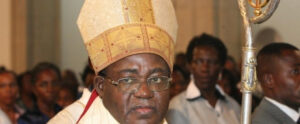
Bishop Damiao Franklin was re-elected Secretary-General
Bishop Silota was re-elected as President of IMBISA, Bishop Zithulele Patrick Mvemve re-elected Vice-President, and Bishop Damião Franklin re-elected Secretary General.
The members of IMBISA also voted unanimously to continue meeting in plenary session every three years, pointing out that the importance of strengthening relationships in the region far outweighed any cost involved.
Sources
IMBISA. 1998. Minutes of the IMBISA Fifth Plenary Assembly. The powerful Word of God. 6 -12 June 1998, Manzini Swaziland. Harare: IMBISA.
On synodal journey for 50 years
In celebration of the golden jubilee of IMBISA, formed in 1975, we publish snippets of history once a week.