


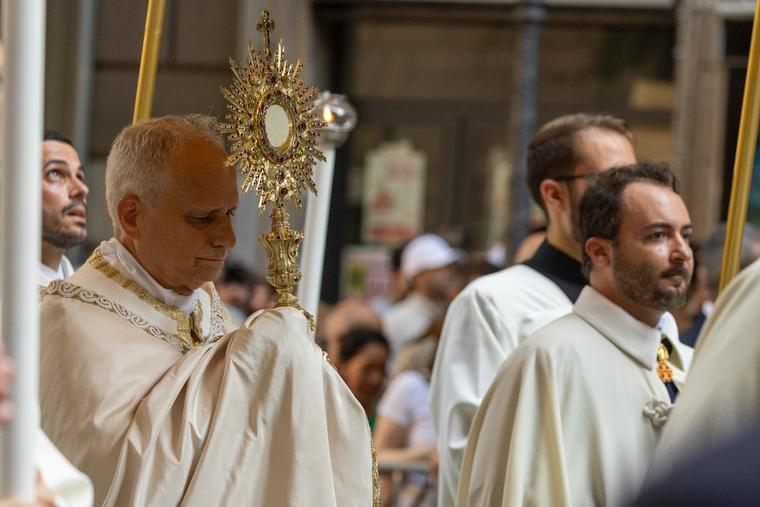
Today we celebrate with pomp and ceremony one of the most beautiful gifts God gave us, the Eucharist.
In that poem St. Thomas Aquinas composed when this feast was instituted in the thirteenth century, the one we sing two verses from in Benediction, we find a summary of what the Eucharist does for us, in which we partake every Sunday or even every day.
Those two verses are summarised even further in the Magnificat antiphon of today’s feast:
O sacred feast, in which we partake of Christ: his sufferings are remembered, our minds are filled with his grace and we receive a pledge of the glory that is to be ours, alleluia.
His sufferings are remembered
To God’s people on their journey together from slavery to freedom, Moses said, as our first reading states: “Remember how the Lord your God led you, how he fed you”.
Well, the Eucharist helps us to not only remember his sufferings, but to make it present here and now, in the times and circumstances in which we live. In fact, that is what remembering does – when we keep the memorial of his suffering ritually at mass, it is not a thing of memory that happens, it is happening for real.
In that mysterious way that God works, what Christ has suffered on the cross comes to touch all of history right until the end of time. And it is saved. That is why we can sing or say at mass, not once but several times, “Lamb of God, who takes away the sin of the world”.
Our minds are filled with his grace
The Eucharist fills our minds with his grace. You remember the verse from Deuteronomy, the Great Shema as it is known in its original Hebrew form, the verse which Jesus quoted when someone asked him what is the greatest of all commandments? Here it is:
Hear, O Israel: the Lord our God is one Lord; and you shall love the Lord your God with all your heart, and with all your soul, and with all your might. And these words which I command you this day shall be upon your heart; and you shall teach them diligently to your children, and shall talk of them when you sit in your house, and when you walk by the way, and when you lie down and when you rise (Deuteronomy 6:4-7).
That is how the grace of God fills us: our heart, our soul, our strength. It fills the whole of our being to the extent that we talk about it day and night in all we do and say.
Again in the first reading, Moses said to the people, the Lord fed you from heaven “to make you understand that man does not live on bread alone but on everything that comes from the mouth of the Lord.”
And we receive a pledge of the glory that is to be ours
Heaven is on our minds and in our reach. That is what the Eucharist does. It brings heaven onto the earth, makes us taste what we will be feasting on at the heavenly banquet. Or put in other words, the words of Jesus to his disciples that we hear in the gospel on this day:
I am the living bread which has come down from heaven. Anyone who eats this bread will live for ever (John 6:51).
Open to us the treasures of your love, we pray in one of the Morning Prayer intercessions. In the Eucharist, out of all the graces God gives us, he has done just that. Opened up for us the treasures of his love. But it is a love of the kind that goes beyond this world to the glory that is to come.
How else to approach him but with awe and trembling?
As we leave the celebration of the Eucharist
It is indeed one of the most beautiful gifts, yes, but also one of the most difficult meals to eat, to be present at, to be invited to.
Since it was given to take away the sins of the world, it places that very same obligation on me, the invited, to not only take my sins away, but that of others. Or to put it simpler, to do what the Lord’s Prayer binds me to do: forgive others as I am asking the Lord to be forgiven. Such is this Eucharist before whom we bow today.
Yet to this heavenly gift, to this bread which has come down from heaven, I find that, having eaten my fill, I often go back to using it rather as a tool of power over against others, not one of forgiveness and love. Never: they are not worthy.
May this ugliness melt away before the fire of God’s love in this beautiful gift of bread and wine, his body and blood.