


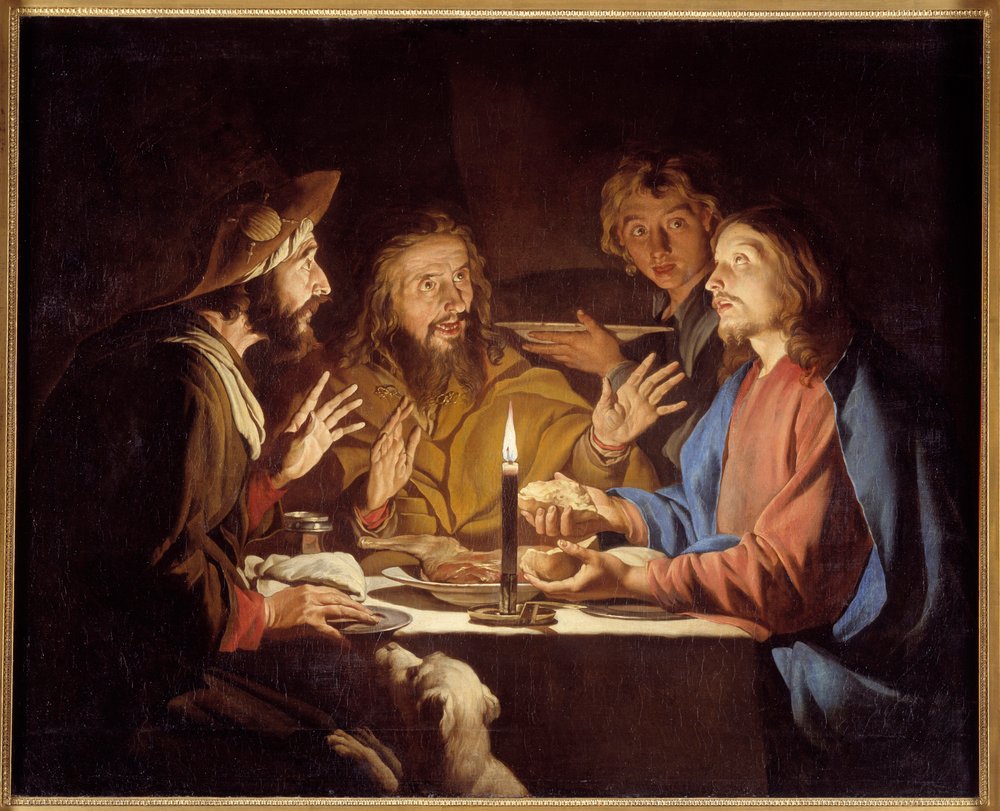
Jesus, Cleopas and Me
The Gospel of the Emmaus journey presents us with three protagonists. Jesus joins two disciples, but only one is named: Cleopas. The other remains unnamed.
When that happens in the New Testament, it is often an invitation. It allows each one of us to enter the story. The unnamed disciple is you. The unnamed disciple is me.
The two are leaving Jerusalem—the place of hope, of promise—and they are walking away disillusioned. Saint Luke tells us they were downcast. As they walk, they are deep in conversation, trying to make sense of what has happened.
Cleopas explains everything to Jesus. But notice something striking: everything he says is in the past tense. Even hope—“we had hoped.” Hope itself has been buried. For them, Jesus is now a figure of the past.
But Jesus cannot be confined to the past. He is alive. He is present. He is walking right beside them, even though they do not recognise him.
Cleopas says something else that is revealing: “Our chief priests and rulers handed him over to be condemned to death and crucified him.” There is an uncritical tone there—our leaders. It reflects something we still see today: the tendency to hold on to leaders, even when they fail us, when they promote the culture of death and even when they distort the truth.
And Cleopas does not speak only for himself. He speaks also for the unnamed disciple—the one who represents us. How often do we remain silent, allowing narratives to be shaped around us, on our behalf, without making our own position clear?
These disciples are trapped in the past, and that is the root of their disillusionment.
They represent all those whose plans have failed, those who have experienced loss, disappointment, or broken relationships. They represent every moment in our lives when things do not turn out as we had hoped.
Yet Jesus does not abandon them. He walks with them.
And then he begins to open the Scriptures to them. He shows them that the answers to their deepest questions were already present in the Word of God.
We see the same in the first reading, where Peter explains that even Psalm 16 was already pointing toward the Resurrection. What seemed ancient and distant is revealed to be alive and meaningful.
Jesus does the same for the Emmaus disciples—and for us. He invites us into a living relationship with Scripture. Because within the Word of God, we often find light for the most painful and confusing parts of our lives.
Then the journey reaches its climax.
As is now the pattern in the life of the Church, Jesus moves with them from the breaking of the Word… to the breaking of the Bread.
And it is there, Saint Luke tells us, that their eyes are opened and they recognise him.
Many of us can recall moments like that in our own lives—times when we felt burdened, disillusioned, even broken, yet we continued to come to Mass. We did not always recognise him immediately. But slowly, gradually, something began to change.
In the Eucharist, we stand only to gain. Because we are not alone. We are there with Cleopas, with the unnamed disciple, with all who are searching. And most importantly, the Risen Christ is there with us. There, he heals our wounds. There, he nourishes our deepest hunger.
Even as a priest, I know what it is to come to the altar carrying a deep sense of brokenness—moments when the hunger for the Eucharist is almost overwhelming. In those moments, I remember that journey to Emmaus. Cleopas and I, I remember that he meets us precisely there.
After Jesus breaks the bread, he vanishes from their sight. But something has changed. They say to one another: “Were not our hearts burning within us?”
That is the turning point.
They rise immediately and return to Jerusalem—to the community they had left behind. Because now, Jesus is no longer external to them. He is within them. He has become part of their very being. He is not in the past.
It is now Christ in Cleopas.
It is now Christ in me.
It is now Christ in you.
The Risen Lord, given to us in the Eucharist, rekindles the flame within us. He restores meaning. He renews our zest for life.
This is the gift of Easter. But it is also the gift of every Eucharist.
Our hearts do not burn because we have everything figured out. They burn because we have encountered Mystery. They burn because we have allowed ourselves to be touched by the living Word. And in that encounter, our eyes are opened.
May the celebration of the Resurrection in the Eucharist bring meaning to our stories, healing to our wounds, and light to our journey—as it did for Cleopas, for the unnamed disciple, may it do so for each one of us.