


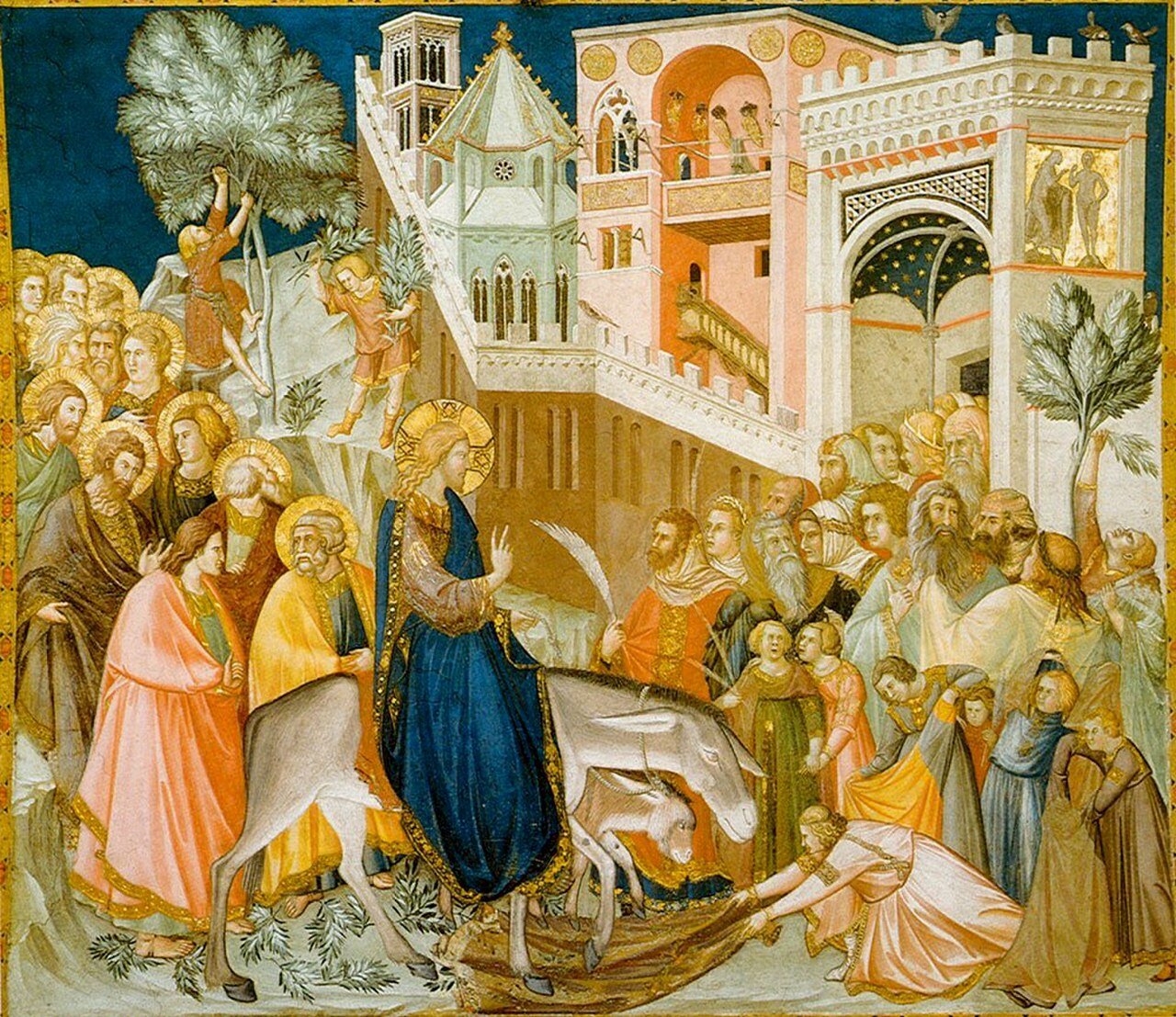
Today, we celebrate Palm Sunday amid numerous wars around the world, with many promoting military force over dialogue, especially in the Middle East, which Pope Leo XIV has called a ‘scandal’ to humanity. One notable aspect of today’s Liturgy is the Triumphal entry into Jerusalem, where Jesus rides a donkey, symbolizing a King who comes in peace. The world faces the great temptation to ride on a horse rather than a Donkey. Horses may bring submission but not peace. War. In this atmosphere of fear and anxiety, the world longs for the power and kingship of Jesus. It is this path that can inspire hope for peace in the world today. In a world where success is measured by power, wealth, influence, and dominance, Jesus’ choice of a donkey remains a radical challenge.
Palm Sunday marks the beginning of Holy Week, a solemn time when the Lord Jesus approaches the end of his earthly mission. We are nearing the conclusion of our Lenten journey, which has prepared us for the Easter celebration. Holy Week is the most sacred week in the Catholic liturgical calendar. During this time, we observe Palm Sunday and the Easter Triduum, the highlight of the Liturgical Year, from Holy Thursday evening to Easter Sunday evening. The Triduum marks the end of the Lenten season and leads to the Mass of the Resurrection of the Lord at the Easter Vigil.
The Palm Sunday Mass commemorates Jesus’ triumphant entry into Jerusalem, where he rode a donkey and was welcomed by crowds praising him as the Son of David and King of Israel. The first reading from Isaiah 50:4-7 highlights a servant of God, described as a skilled teacher who remains faithful to God’s will despite facing persecution and suffering. The servant trusts in God’s protection and ultimately overcomes his oppressors.
The second Reading from St. Paul’s letter to the Philippians (2:6-11) illustrates the humility of Jesus Christ, who, though divine, chose to become human and endure suffering on the cross. Through his obedience, God exalted him, giving him a divine name so that every knee will bow and every tongue confess that Jesus Christ is Lord.
The Gospel is taken from Matthew. The Passion reading describes the events leading up to Jesus’ crucifixion and death, including his betrayal by Judas Iscariot, his arrest and trial before the high priest, his denial by Peter, his sentencing by Pilate, his crucifixion and death, and his burial in a tomb.
Today, we will witness processions of people around the world singing “Hosanna to the Son of David! Blessed is he who comes in the name of the Lord!” This event is not just a ritual. It has deep meaning and implications for the world today. Jesus travels to Jerusalem to fulfill the Scriptures and to be crucified on the Cross. The cross is the throne on which he draws all humanity to himself, the throne from which he will reign forever. During the entry into Jerusalem, the people pay homage to Jesus as the Son of David with the words of Psalm 118 [117] : “Hosanna to the son of David! Blessed is he who comes in the name of the Lord! Hosanna in the highest of heavens!” (Matthew 21:9).
Jesus is revealed as the sovereign King who has the authority of heaven but comes in peace with humility. As He enters Jerusalem, He is heralded as the coming Messiah who brings salvation. As Zachariah prophesied, the Messiah would come “riding on a donkey, on a colt, the foal of a donkey.” Why did Jesus choose a donkey in the first place? The top Roman soldiers of Jesus’s day rode on fancy, majestic horses as a display of power and status. Jesus is the King, but not an earthly king as some imagined, rather the true King who reigns forever in love and forgiveness.
We are currently living in a language of power, strength, and war where leaders seize power by force or coercion. The leaders of powerful nations today love to show their power, to even flex their military muscles. We hear about B-2 stealth bombers, armed with 2,000 lb. bombs, ballistic missiles, cruise missiles, more lethal militaries, improved nuclear deterrents, better aircraft, and surface warfare ships and submarines. We know of the power, pride, and prestige associated with America’s Air Force One, Russia’s Flying Kremlin, Israel’s Wings of Zion, and South Africa’s Inkwazi. These are symbols of power and strength.
And then enters Jesus, with a different logic, a prophetic and revolutionary meaning. This is a powerful lesson today on the values of peace and humility. Jesus reminds us that leadership and strength are best expressed through service and love, offering a timeless message that resonates with believers and leaders worldwide. Jesus is a humble, peaceful, Davidic King who invites every heart to receive Him, not on worldly terms but on His terms—gentleness and truth.
Jesus is not a political king or a conqueror. He did not come as a warrior crushing His enemies but as a servant who saves through love and sacrifice. Jesus is the King who defies expectations. While political leaders sought to dominate by force, Christ would reign through service. Today, many leaders chase “horses” (power, violence) while Jesus calls us to humility and service over domination and peace over violence. His reign is built on serving, not being served. Jesus is offering a different kind of kingdom. By choosing to ride on a donkey, political leaders sought to dominate by force; Christ would reign through service. His kingdom is not imposed by the sword but through love and surrender.
As global attention is gripped by wars in the Middle East and other geopolitical crises, we have to pay attention to our own horses and riders. Political violence, coercion, and gender-based violence are realities we are faced with and have to address them with the courage inspired by the Word of God and the Holy Spirit. When power and privilege are disproportionately held by politicians in the government, men in patriarchal society, or religious men and women in the Church, it results in abuse and not service.
As we acclaim Christ as King, we need to understand and embrace his throne, the Cross. We need to renew our faith and remember that true power lies in love, that true greatness is found in humility. The world was saved by the way of humility and love, and today the world will be saved in the same way.